“...I've been working since 2008 with Ruby / Ruby on Rails, love a bit of Elixir / Phoenix and learning Rust.
I also poke through other people's code and make PRs for OpenSource Ruby projects that sometimes make it
Currently working for GenieBelt who are based in Copenhagen, Denmark ...”
I’ve been using simple_form for as many years as I can remember. I love it’s simplicity. We’ve been adopting DRY since we all first adopted Rails back when we were less grey. So every time you see a form input like this it pains me.
This example is a simple one, it doesn’t even cater for errors, placeholders, hints and even left / right alignment of inputs based on different situations.
I know we’re going to repeat this about 400 times in our application and if we want to upgrade from Bootstrap 4 to Bootstrap 5 or another CSS framework, or something custom we’re going to have to rewrite every form on the site which could take months and a developer out of circulation to do this. If you ever need an excuse not to do something. (Let’s not upgrade to Bootstrap 5 it will take a year and cost $1Billion). This is a big one.
SimpleForm offers the ability to reduce that code into one line per form group. It makes reasonable guesses about what kind of form element you want based on the data type of the Boolean is check_box, String is text, etc. However it’s customizable so you can determine on a per input basis what it should be.
SimpleForm is ridiculously customisable and it caters for so many eventualities. Your form element could have 100 variations and SimpleForm’s not so simple config file will aid you to nail your form layouts. Trouble is your simple_form config can end up looking like this. Show that to your UX/UX peeps and they will stare blankly back at you and say things like WTF, or “you’re having a laugh” or worse “NO”.
This kind of thing works if you’re a seasoned developer, and you can remember exactly what you did last week. But if you’re anything like me I jump from thing to thing and often don’t get a chance to take stock of everything before jumping into something else. But it occurred to me this morning that it’s not SimpleForm that I’m in love with it’s the simplicity I’m in love with and the implementation I can accept is pretty cool and I like to see elaborate things but I’m not particularly in love with the way it doesn’t allow everyone in the team to understand it without a week of poking it with a stick and in the end it’s a hinderance to development.
I can offer a different solution however, Rails has offered us a way to use custom FormBuilder and has since forever. It’s very nice to have a singing dancing solution, but a simple one will suffice. A simple solution needs to have some flexibility but it only needs to cater for the needs of our team not for every Ruby outfit on the planet.
We could easily just build our own solution but for the sake of our sanity make it compatible with SimpleForm arguments so we can just swap this in by changing simple_form_for with another_form_for.
class AnotherFormBuilder < ActionView::Helpers::FormBuilder
  def input(method, options = {})
    # delegate to a single method for each kind of form input based on type or options[:as]
  end

  def string
  end

  def time_picker
  end

  def toggle_switch
  end
end

def another_form_for(name, &block)
  form_for(name, builder: AnotherFormBuilder, &block)
end
I did a bad and ploughed into creating an update function for my form and woah begads I broke something.
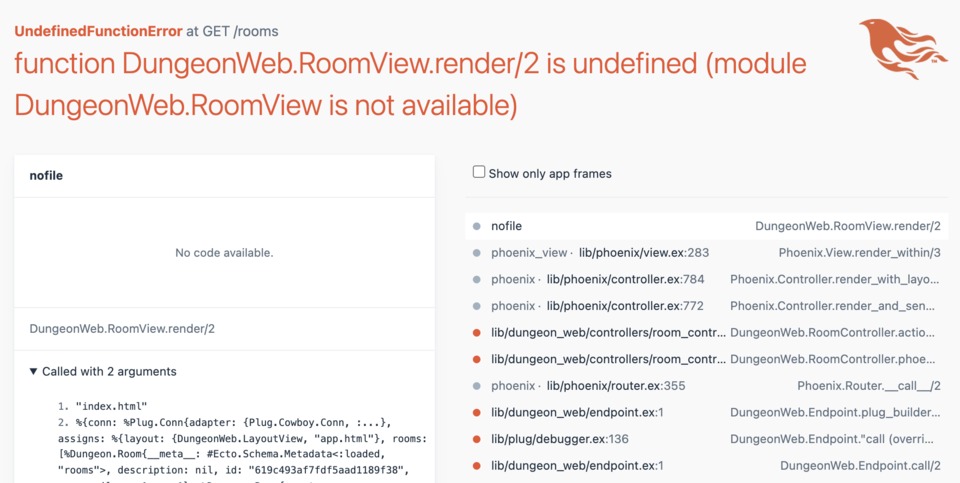
UndefinedFunctionError at GET /rooms
function DungeonWeb.RoomView.render/2 is undefined (module DungeonWeb.RoomView is not available)
Now DungeonWeb.RoomView.render/2 is not there. In the backtrace it even suggests there’s nofile. There totally is…
defmodule DungeonWeb.RoomView do
  use DungeonWeb, :view
end
Not entirely sure what could cause this or cause the room_view.ex not to be loaded :S
UPDATE: 29/11/2021
It would appear that saving and changing just whitespace on my rooms/index.html.heex fixed everything. Huh? So there’s some kind of template cache that can get messed up?
There is nothing worse than working through a programming textbook and everything working first time. Sometimes the best way to learn is to see backtraces, and broken stuff all over the place. I’ve been working full time as a programmer for over 10 years and while I’m experienced, if there is a possibility for something to break I seem to find it without fail.
I also systematically go through eBay and pick up older Pragmatic Programmers books because I just love the presentation, they’ve nailed it and every read is just a comfortable. However, my £4 Programming Phoenix book means that I’m about 5 years out of date and so everything doesn’t work first time. But that’s ok, I’m learning and finding out stuff by breaking stuff.
Today it’s working out Ecto changeset. Firstly the cast function was missing, so I needed to add import Ecto.Changeset
defmodule Dungeon.Room do
  use Ecto.Schema
  import Ecto.Changeset

  @primary_key {:id, :binary_id, autogenerate: true}
  schema "rooms" do
    field :name, :string
    field :x, :integer
    field :y, :integer
  end

  def changeset(model, params \\ :empty) do
    model
    |> cast(params, ~w[name x y], [])
    |> validate_length(:name, min: 1, max: 30)
  end
end
And now….
Ecto.CastError at GET /rooms/new
expected params to be a :map, got: `:empty`
It appears that cast takes a :map and we’ve defaulted to :empty and cast is now kicking off :S
I can’t replace it with…
def changeset(model, params \\ %{}) do   model
  |> cast(params, ~w[name x y], [])
  |> validate_length(:name, min: 1, max: 30)
end
…since cast is expecting name, x, or y. Oh right. Ok the fourth argument to cast/4 is optional keys. This will be pretty lame since every empty Room struct will have no name, x, or y. So there’s got to be something else missing here :S
def changeset(model, params \\ %{}) do
  model
  |> cast(params, [], ~w[name x y])
  |> validate_length(:name, min: 1, max: 30)
end
Hmmzzz….
It would appear that my name, x, and y are all empty.
def changeset(model, params \\ %{}) do
  model
  |> cast(params, ~w[name description x y]a, [])
  |> validate_length(:name, min: 1, max: 30)
end
Seems we need a list of atoms rather than strings so.
~w[name x y]a
Ok, queen….I’ll check the Ecto documentation. I can read that too right?
defmodule User do
  use Ecto.Schema
  import Ecto.Changeset

  schema "users" do
    field :name
    field :email
    field :age, :integer
  end

  def changeset(user, params \\ %{}) do
    user
    |> cast(params, [:name, :email, :age])
    |> validate_required([:name, :email])
    |> validate_format(:email, ~r/@/)
    |> validate_inclusion(:age, 18..100)
    |> unique_constraint(:email)
  end
end
OK, looks like this \\ :empty isn’t the right thing to do.
Every time I try and upgrade anything through brew I appear to get node linked to v17. Nope, v17 doesn’t work with our current set up. Something to do with node-sass that isn’t resolved yet. Anyway, I still have v14 installed and I need to keep re-linking it like so.
Robs-MacBook-Pro:rostering rl$ node -v
v17.0.1
Robs-MacBook-Pro:rostering rl$ brew link --force --overwrite node@14
Linking /usr/local/Cellar/node@14/14.17.0... 3986 symlinks created.

If you need to have this software first in your PATH instead consider running:
  echo 'export PATH="/usr/local/opt/node@14/bin:$PATH"' >> /Users/rl/.bash_profile
Robs-MacBook-Pro:rostering rl$ node -v
v14.17.0
Started looking at Elixir again. Thinking about building something with MongoDB, and I know that support for MongoDB Ecto but there’s chatter about it and is not quite there but this is an opportunity to start hacking away. Anyway, first point of call. What the hell is Plug anyway, it’s kinda like Rack in Ruby.
I hate clutter. On Kevin ‘s recommendation I bought Disk Daisy to try and clear guff from my Disk, in the same breath as saying XCode isn’t really needed. Yep I just went with it when I got 5Gb updates just so I could install anything. So first call of business….delete XCode. Just nuked that sucker from my Applications folder. Everything still seems to work. Cool.
However, I might have broken something.
Robs-MacBook-Pro:repos rl$ rbenv install 3.1.0-dev
Downloading openssl-1.1.1l.tar.gz...
-> https://dqw8nmjcqpjn7.cloudfront.net/0b7a3e5e59c34827fe0c3a74b7ec8baef302b98fa80088d7f9153aa16fa76bd1
Installing openssl-1.1.1l...

BUILD FAILED (macOS 11.6 using ruby-build 20210928)

Inspect or clean up the working tree at /var/folders/xr/tb40m1q965n0x4z21sjd9mhh0000gn/T/ruby-build.20211110082145.18668.XUsYq9
Results logged to /var/folders/xr/tb40m1q965n0x4z21sjd9mhh0000gn/T/ruby-build.20211110082145.18668.log

Last 10 log lines:
***                                                                ***
***       perl configdata.pm --dump                                ***
***                                                                ***
***   (If you are new to OpenSSL, you might want to consult the    ***
***   'Troubleshooting' section in the INSTALL file first)         ***
***                                                                ***
**********************************************************************
xcrun: error: active developer path ("/Applications/Xcode.app/Contents/Developer") does not exist
Use `sudo xcode-select --switch path/to/Xcode.app` to specify the Xcode that you wish to use for command line developer tools, or use `xcode-select --install` to install the standalone command line developer tools.
See `man xcode-select` for more details.
Ok, so we still need command line tools. I knew that but I kinda assume they were installed alongside XCode not as part of it. It does appear that you can install them manually on their own.
Same issue. Do I need to force the Terms and Conditions confirmation again.
Robs-MacBook-Pro:repos rl$ xcode-select --install
xcode-select: error: command line tools are already installed, use "Software Update" to install updates
Not can’t even do that.
Robs-MacBook-Pro:repos rl$ xcode-select -h
Usage: xcode-select [options]

Print or change the path to the active developer directory. This directory
controls which tools are used for the Xcode command line tools (for example,
xcodebuild) as well as the BSD development commands (such as cc and make).

Options:
  -h, --help                  print this help message and exit
  -p, --print-path            print the path of the active developer directory
  -s <path>, --switch <path>  set the path for the active developer directory
  --install                   open a dialog for installation of the command line developer tools
  -v, --version               print the xcode-select version
  -r, --reset                 reset to the default command line tools path
Only option I really have is to reset the Command Line Tools path.
sudo xcode-select --reset
And boom….!
rbenv install 3.1.0-dev
Downloading openssl-1.1.1l.tar.gz...
-> https://dqw8nmjcqpjn7.cloudfront.net/0b7a3e5e59c34827fe0c3a74b7ec8baef302b98fa80088d7f9153aa16fa76bd1
Installing openssl-1.1.1l...
Installed openssl-1.1.1l to /Users/rl/.rbenv/versions/3.1.0-dev

Cloning https://github.com/ruby/ruby.git...
Installing ruby-master...
ruby-build: using readline from homebrew
Installed ruby-master to /Users/rl/.rbenv/versions/3.1.0-dev
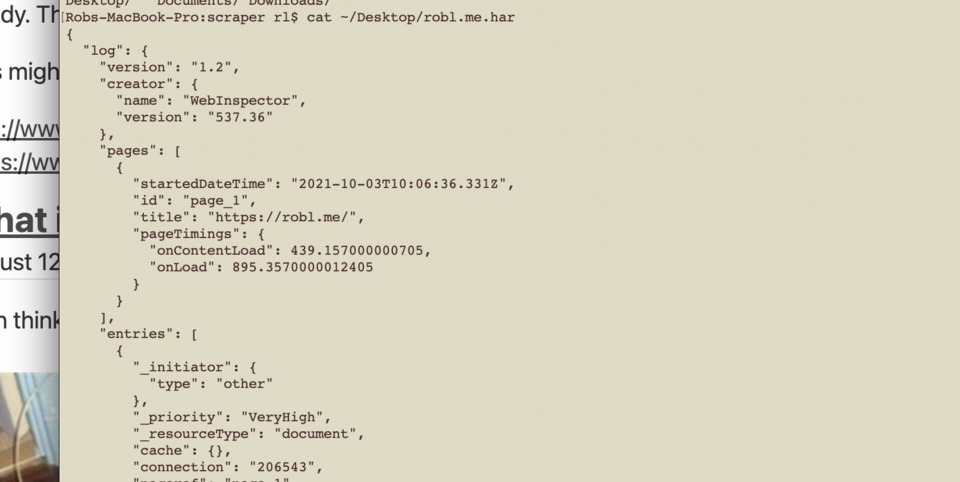
The HTTP Archive format, or HAR, is a JSON-formatted archive file format for logging of a web browser’s interaction with a site. The common extension for these files is .har
Awesome. Google Chrome allows you to export a session of network traffic as an HAR, as do a number of others. Nice. If you’re scraping a website and want to capture the requests that help construct that page e.g. a single page JS application that makes 10 calls to a JSONAPI. Automate this and you’ve got quite an arsenal, you can part scrape a page’s content, grab urls of all images loaded, pinch cookies, etc all from the HAR.
Tell me more, how do I construct my own????
The specification for this format is produced by the Web Performance Working Group1 of the World Wide Web Consortium (W3C). This document was never published by the W3C Web Performance Working Group and has been abandoned